Seedance 2.5 Flash: Generate a 4 to 30 Second Clip From a Prompt
Seedance 2.5 Flash turns a text prompt into a finished clip — 4 to 30 seconds long, at 480p or 720p, with synchronized audio generated in the same pass. The generator on this page calls the bytedance/seedance-2.5/flash/text-to-video endpoint, locks the model, and shows the credit cost before you spend. Pick a duration, pick a resolution, and the cost updates as you move the slider. The naming note below explains why ByteDance's own Seedance 2.5 page says 2.5 while the hosted endpoint adds the Flash label.
Seedance 2.5 Flash Text-to-Video Generator
Write a prompt, choose 4 to 30 seconds and 480p or 720p, then generate a clip with synchronized audio. Credits are priced per second of output and shown before you generate.
No videos generated
What Is Seedance 2.5 Flash?
Seedance 2.5 Flash combines ByteDance's Seedance family name, the 2.5 version marker, and the Flash label the hosted endpoint uses for its faster text-to-video surface. The endpoint behind this page is bytedance/seedance-2.5/flash/text-to-video: a text prompt goes in, a single video file and its seed come out, with synchronized audio included by default. ByteDance Seed's own Seedance 2.5 page also describes reference-video input and editing controls, which this text-to-video endpoint does not expose. Everything below separates what this page can actually generate from what the broader model description claims.
The Model Name
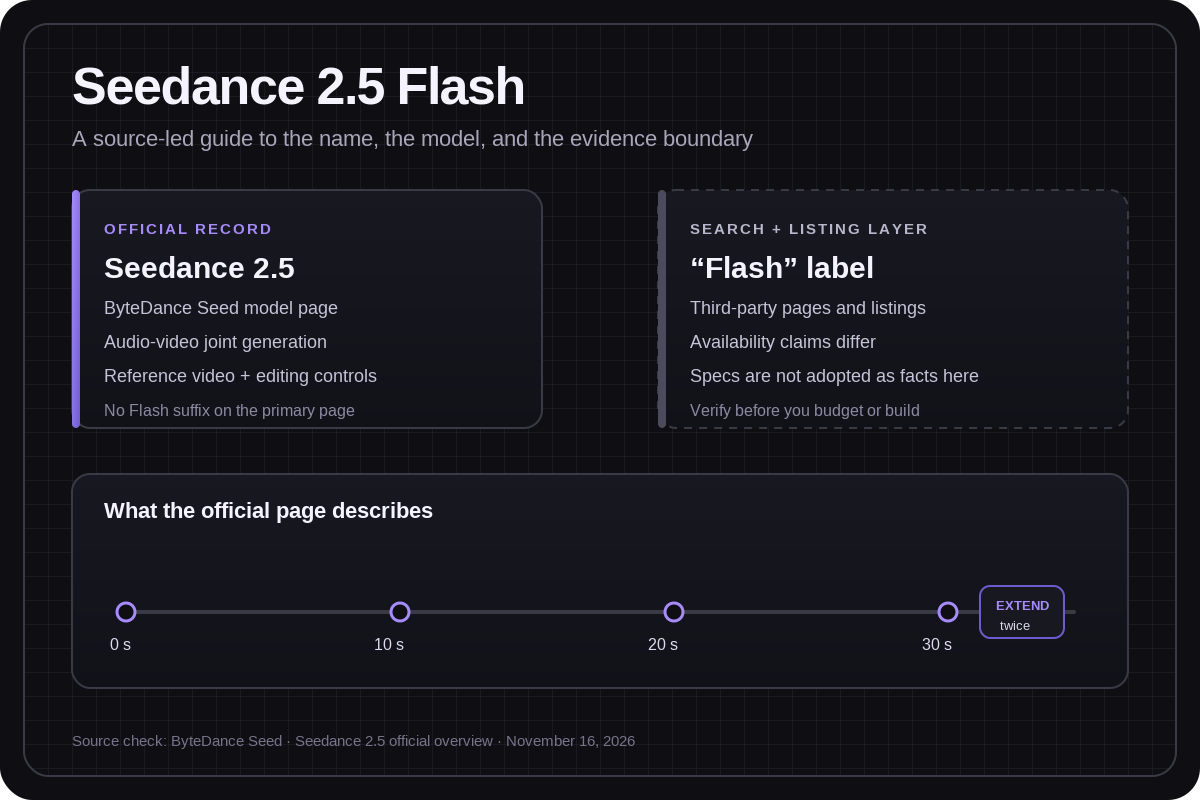
ByteDance Seed publishes the family as Seedance 2.5. The endpoint this page calls adds Flash and the text-to-video task name, which is why the search phrase and the official name differ by a word.
What Flash Changes
Flash marks the faster hosted text-to-video surface on the 2.5 release line. It publishes its own duration, resolution and aspect-ratio menus, and prices them per second of output.
Text to Video, Not Editing
This page exposes prompt, duration, resolution, aspect ratio and audio. Reference-video input and the editing controls described by ByteDance belong to the wider model story but are not parameters of this endpoint.
What You Get Back
One video file and the seed used to render it. There is no batch option here: each generation is a single clip, so a 30 second scene is one call rather than a sequence of short cuts.
Seedance 2.5 Flash: Reading the Name and the Evidence
A model name is not a specification sheet. This Seedance 2.5 Flash reference separates the family name, the version, the Flash qualifier and the endpoint facts that decide what you can generate.
Family Name: Seedance
Seedance is the video-generation family named by ByteDance Seed. Starting with the family narrows the search and prevents a Flash listing from being confused with an unrelated image model.
Version Marker: 2.5
The 2.5 marker identifies the current model page in the Seedance family. Version numbers matter because features, input rules, and commercial terms can change between releases.
The Flash Qualifier
Flash names the hosted text-to-video endpoint rather than a separate ByteDance release. The endpoint id, bytedance/seedance-2.5/flash/text-to-video, is the string to quote when you compare providers or file a support ticket.
Primary Source Versus Listing
A vendor overview, an API gallery and a search result are different kinds of evidence. This page quotes the Seedance 2.5 Flash endpoint's own queue schema and pricing text for every number, and labels the rest as context.
What Counts as a Verified Spec
A verified spec is a parameter, limit or price published by the source that controls the model. A screenshot, a reseller card or an SEO paragraph is not enough on its own — the endpoint schema is.
What to Check Before You Commit
Before building a workflow around Seedance 2.5 Flash, confirm the endpoint you call, its duration and resolution ceilings, the output rights, the commercial terms and the price you would be billed.
What the Seedance 2.5 Flash Endpoint Actually Gives You
Every point below comes from the Seedance 2.5 Flash endpoint's published input schema and pricing text, checked on November 16, 2026 — not from a third-party listing.
How to Get a Usable Shot Out of Seedance 2.5 Flash
The endpoint is a text-to-video surface, so the work happens in the prompt and in the order you spend credits. Four habits keep a Seedance 2.5 Flash session short.
Start With the Shot, Not the Prompt
The shot list comes before the prompt: what the audience must see, what the camera must do, and whether the scene needs dialogue, ambience or music. A Seedance 2.5 Flash prompt is easier to judge when the creative requirement is fixed and the model is the only variable.
Iterate at 480p, Finish at 720p
Judge motion, framing and audio on a short 480p take, then re-run the version you keep at 720p. The price per second roughly doubles, so the cheap tier is where a shot earns its place.
Plan the Final Length First
Credits scale with duration, not only with the number of attempts. A 30 second 720p clip is about 62 credits, so decide the final length before the last render and keep the exploratory takes short.
Record the Seed With the Brief
The endpoint returns the seed it used. Store it next to the prompt and duration: a later retry with the same seed is comparable, while a different seed is a different shot.
Why the Endpoint Says Flash and ByteDance Says 2.5
Search language and product language do not always match. This Seedance 2.5 Flash naming note explains where the Flash label comes from now that the endpoint is public.
The Official Page Says Seedance 2.5
ByteDance Seed's model page names Seedance 2.5. It does not list Flash as a separate model in its navigation.
The Endpoint Says seedance-2.5/flash
The hosted endpoint id is bytedance/seedance-2.5/flash/text-to-video. Flash is part of the task name the provider publishes, which is why the search phrase and the official name differ.
Availability Is Now a Fact
Earlier third-party listings disagreed about whether a Flash variant existed. The endpoint answers that question: it is live, documented in a queue schema, and priced per second.
Do Not Turn a Label Into a Spec
A speed label still does not set a frame rate, a file-size ceiling or an edit menu. Quote the endpoint's schema, not the label, when you write a brief.
Record the Source Date
Model pages change. Add the date you checked the source to your brief so a later reviewer can tell whether a statement was accurate when the evaluation began.
Send Readers to the Source
A good naming note does not trap the reader in a keyword page. It points to the endpoint's schema and the official Seedance 2.5 page so both can be checked directly.
Seedance 2.5 Flash: Published Parameters and Pricing
Everything below comes from the Seedance 2.5 Flash endpoint's queue schema and pricing text, checked on November 16, 2026.
Endpoint
The Seedance 2.5 Flash endpoint is bytedance/seedance-2.5/flash/text-to-video, a queue endpoint that returns one video file and the seed used to render it.
Prompt
A single text prompt is the only required input. Subject, action, camera movement, lighting and mood all belong in that prompt.
Duration
4 to 30 seconds, chosen per call. The endpoint also accepts auto, which lets the model decide; this page always sends an explicit duration so the charge matches the clip.
Resolution and Aspect Ratio
480p or 720p, and auto, 21:9, 16:9, 4:3, 1:1, 3:4 or 9:16. Orientation is set per call, not per account.
Audio Behaviour
Synchronized audio is generated by default and does not change the price. Switch it off when you plan to lay your own track.
Price per Second
About $0.1442 per second at 480p and $0.3094 at 720p, billed on output length. EaseMaker prices credits from those figures at one credit per $0.15, rounded up.
Frequently Asked Questions About Seedance 2.5 Flash
Short answers about the Seedance 2.5 Flash name, the endpoint contract and what a generation costs.
Generate a Seedance 2.5 Flash Clip, Then Decide What It Replaces
Start with a 5 second clip to judge motion, framing and audio, then move to 480p for cheap iteration or to 30 seconds for the scene you keep. The endpoint's schema and per-second price are listed above; compare them with the other video tools on EaseMaker before you commit a budget.